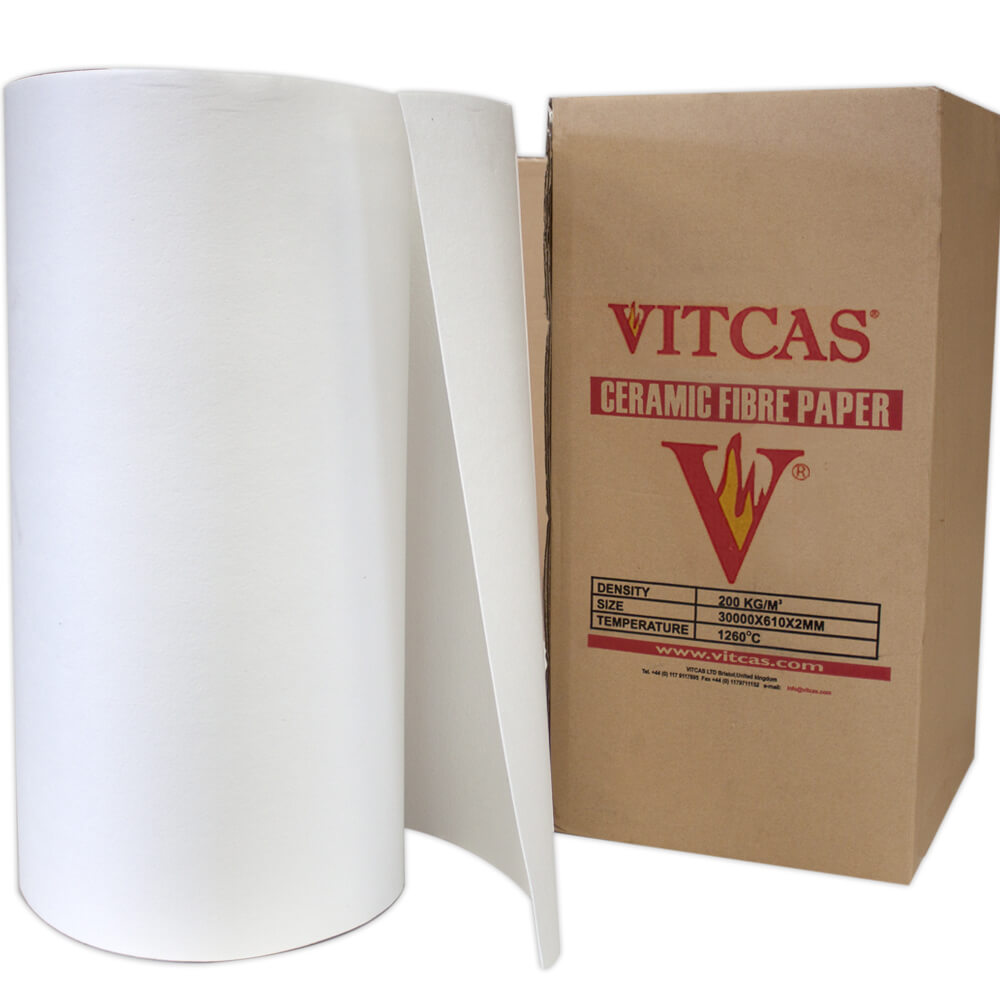
Ceramic paper allows creating a thin layer where that format is specified. It does not solve every space deficiency nor replace arbitrarily thick insulation. Before correcting the assembly, determine the function of the spacer and the required clearance in the actual connection.
Check the exact material
Ceramic Fibre Paper Vitcas is a product made of ceramic fibre for suitable thin gaskets and seals. Do not confuse it with any fibrous paper in the store. Variants with a different composition or thickness have their own documentation.
On the drawing, record the material of both adjacent surfaces and the operating temperature. Determine whether the layer is meant to separate parts, seal, or limit heat flow. The selection is based on this function, not just on the fact that a thin sheet fits in the gap.
Clearance and compression must remain controlled
Measure the space during a cold dry fit and take into account the required compression. Do not add additional layers if they change the closure or position of the part. The movement of the metal part should not be accidentally blocked after inserting the gasket.
Ceramic fibre board has a different format and functions in compatible assemblies. Replacing it with paper solely to reduce thickness requires a reassessment of the entire cross-section. The maximum temperature of both products does not describe the achieved insulation.
Adjust the fastening to the application
Ceramic Fibre Adhesive can be used for the specified retention of compatible fibrous materials. Check the instructions for both products and the substrate. The adhesive should not alter the part that requires later separation or replacement of components.
When cutting, use the variant data sheet and maintain the intended edge protection. Record the thickness and number of layers after completion. This will make it easier to later restore the connection, instead of adding another random spacer to a place whose function remains unknown.